
Port Forwarding
Port forwarding enables you to expose one or more ports of a cloud desktop to the local network or the internet. It is often used with the Remote Desktop Protocol.
This feature can be utilised for both DaDesktop Course machines (which require a private server), DaDesktop For Work, or Standalone machines. Kindly note that the interface may appear slightly different for the different types of machines.
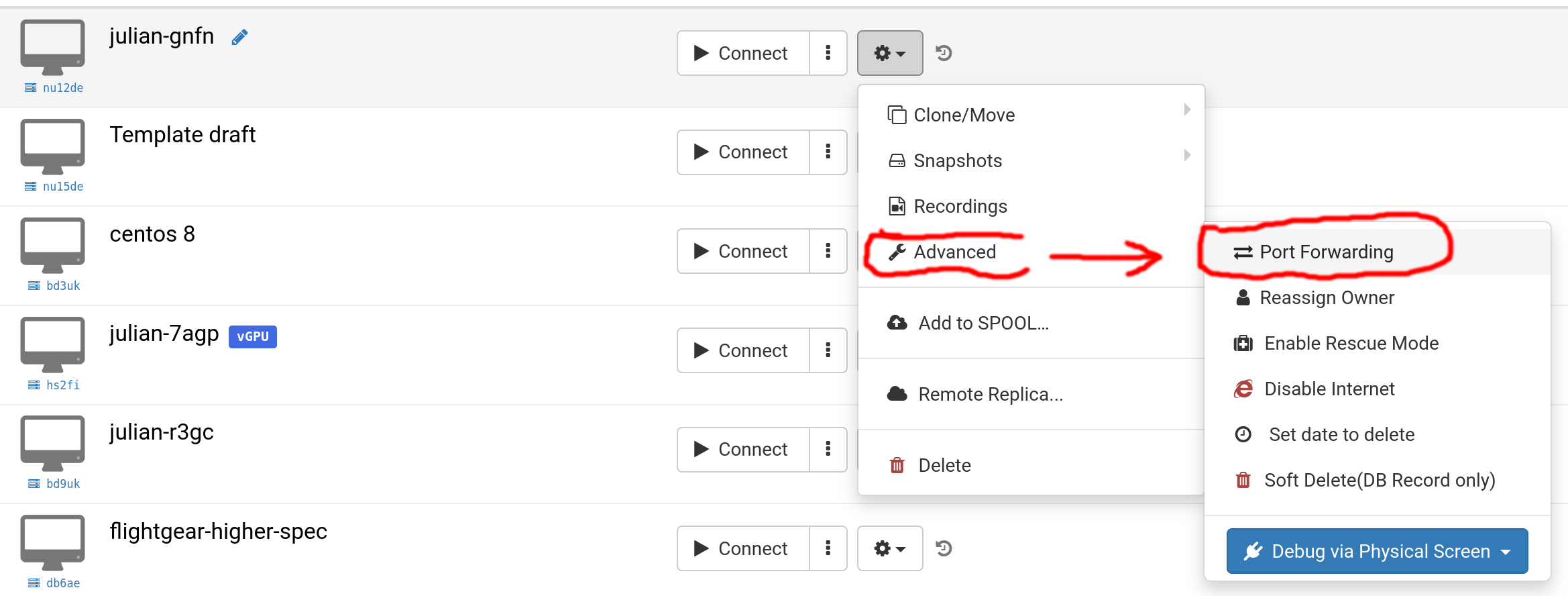
Select 'Advanced' and then 'Port Forwarding'.
Port forwarding can be done using automatic allocation or manual allocation. With automatic allocation, the next available port on the server is used. Typically, auto allocation is preferred to keep things simple, but manual allocation lets you choose each external port if needed, from ports 10000 to 65500. If manual port forwards have been added earlier, they are retained and can be edited as needed.
Auto Allocation
This image displays auto allocation, along with a previously added manual port forward that uses port 11122 on the host and port 22 on the VM.

Manual Allocation
This example demonstrates the use of port 11122 for both TCP and UDP port forwarding to the cloud desktop’s VM port 22 for SSH. UDP and TCP ports can be selected differently if needed.

Example for Windows RDP
This example employs the original manual allocation method, though auto allocation can naturally be used as well.
1. Locate your DaDesktop desktop, click on “Port forwarding”, and specify your TCP ports (for the remote connection). This is the external port number and 3389 (for example, 66666:3389). Kindly make a note of your port number; if you forget it, you can click on Port forwarding once more to retrieve it.

2. Submit and set a password inside your Windows DD machine, then click “Enable Remote Desktop”.

3. On your Windows device, use Remote Desktop and enter the Server name along with the TCP port. (In this example, I am using zh4cn, so it is zh4cn.npg.io:xxxxx). Under ‘Show options’, you can also choose the “resolution” of your remote desktop window, for instance.


3.1 To log in to your DaDesktop remote desktop, by default
“You should reset your username and password in the machine first.”
Then, connect to the remote desktop.

4. You can then have a remote desktop that uses the DD template and sound card from your own device. You can also copy-paste or output documents easily. (The small window on the left shows the DD remote desktop with audio.)
